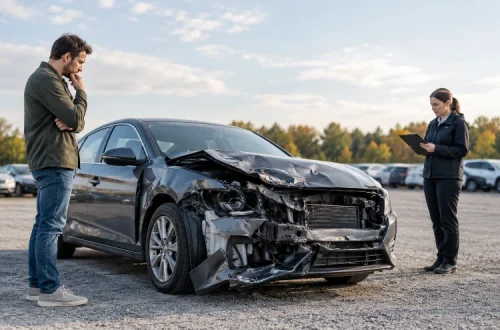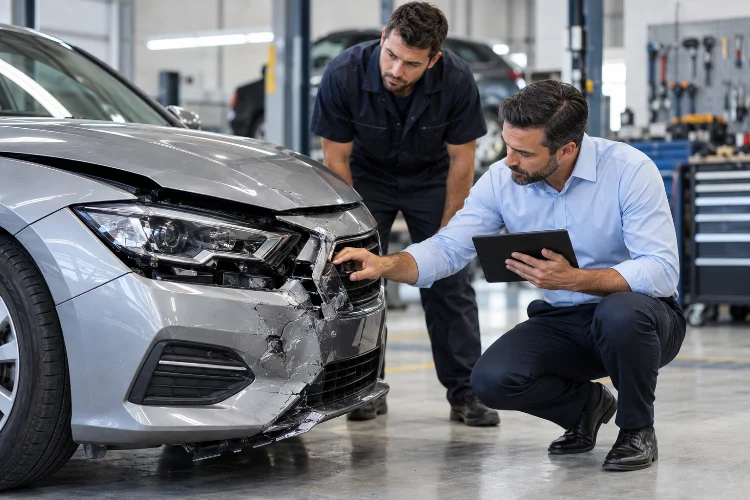
Imagine getting into a minor car accident on your way home. Your front bumper is cracked, one headlight is damaged, and the hood looks slightly misaligned.
You assume the repairs might cost around $1,000.
Then the insurance company’s claims adjuster inspects your vehicle, reviews the damage, and produces an estimate that’s significantly higher than you expected.
Or maybe the opposite happens. Your local repair shop quotes $4,500, but the insurer initially approves only $2,800.
Confusing, right?
Understanding how claims adjusters evaluate vehicle damage and repair costs can make the entire insurance claims process much less frustrating.
Claims adjusters play an important role in determining which damages are covered, how much repairs should cost, and whether a damaged vehicle should be repaired or declared a total loss.
Their decisions involve more than simply looking at dents and scratches.
Modern repair estimates consider labor rates, replacement parts, hidden structural damage, electronic systems, and insurance policy conditions.
In this guide, we’ll explore how vehicle damage assessments work, what influences repair estimates, and how drivers can navigate the process more confidently.
1. Understanding the Role of a Car Insurance Claims Adjuster
When you file an auto insurance claim, one of the first people involved is usually a claims adjuster.
Their primary responsibility is to investigate the reported loss and help determine what the insurance company should pay under the applicable policy.
That sounds straightforward, but the job involves several important decisions.
What Does a Claims Adjuster Actually Do?
An adjuster reviews accident information, examines available evidence, evaluates insurance coverage, and determines which damages are related to the reported incident.
Depending on the insurer, a separate vehicle damage appraiser or estimator may handle the technical repair estimate.
According to the National Association of Insurance Commissioners (NAIC), insurers may assign company-employed adjusters or independent contractors to investigate claims and evaluate losses.
For example, imagine another driver hits your vehicle while you’re waiting at a traffic light.
The adjuster may review photographs, driver statements, accident reports, repair estimates, and insurance policy details before recommending a settlement.
The purpose is to establish which damages are connected to the accident and calculate the amount payable under the relevant coverage.
Insurance Coverage Comes Before Repair Costs
Here’s something many drivers overlook: an expensive repair doesn’t automatically mean the insurer must pay for it.
The damage must fall within the coverage provided by the insurance policy or an applicable liability claim.
If you damage your own vehicle in an at-fault accident, collision coverage may pay for eligible repairs.
If the vehicle is damaged by hail or vandalism, comprehensive coverage may apply instead.
An adjuster also considers deductibles, coverage exclusions, prior damage, and policy limitations.
Understanding these factors helps explain why an insurer’s payment sometimes differs from the full repair bill.
2. How Claims Adjusters Perform the Initial Vehicle Inspection
The initial inspection is one of the most important steps in the claims process.
It establishes the visible condition of the vehicle and provides the foundation for the first repair estimate.
However, this assesment isn’t necessarily the final determination of all repair costs.
Reviewing the Accident and Damage Evidence
The process typically begins with information supplied by the policyholder or claimant.
This might include photographs, a description of the accident, the date and location of the incident, and contact details for other people involved.
The adjuster may compare this information with the visible damage to determine whether the reported incident reasonably explains the vehicle’s condition.
For example, a rear-end collision usually creates a different damage pattern from a side-impact accident.
Evidence helps distinguish accident-related damage from unrelated scratches, existing dents, or previous repairs.
The California Department of Insurance explains that a qualified adjuster or appraiser usually inspects vehicle damage before preparing an initial estimate.
Physical Inspections and Digital Assessments
Traditionally, an adjuster would inspect a damaged vehicle in person.
Today, some insurers also use photographs, mobile claim applications, and remote estimating systems.
Minor cosmetic damage may be relatively easy to evaluate from clear photographs.
More complicated accidents often require a hands-on examination, especially when structural components, suspension systems, or electronic equipment might be affected.
Digital tools can speed up the process, but they don’t eliminate the need for professional judgment.
A photograph might show a cracked bumper without revealing the damaged support structure underneath.
That’s one reason the initial estimate can change after the repair shop begins disassembling the vehicle.
3. How Vehicle Repair Costs Are Calculated
Once the damage has been documented, the next step is estimating what it should cost to restore the vehicle to its appropriate pre-accident condition.
This involves evaluating replacement parts, labor, refinishing work, materials, diagnostics, and additional procedures required for a proper repair.
Claims professionals often use specialized estimating software to organize the calculations.
Replacement Parts and Materials
The first major category involves the damaged components.
A repair estimate might include a replacement bumper cover, headlight assembly, radiator support, damaged sensors, and other necessary parts.
However, not every damaged component needs complete replacement.
Some body panels can be repaired rather than replaced, depending on the material, extent of damage, manufacturer procedures, and safety requirements.
The adjuster or appraiser evaluates which operations are appropriate for the documented loss.
Labor Rates and Repair Time
Labor costs can represent a substantial portion of the final estimate.
Auto body work, mechanical repairs, refinishing, and specialized electronic procedures may have different labor rates.
For example, suppose repairing a damaged vehicle requires eight hours of bodywork at an illustrative rate of $80 per hour.
That creates $640 in body labor charges.
If the job also requires six hours of paint labor at $85 per hour, another $510 is added.
These figures are hypothetical. Actual rates and estimating practices vary significantly by location, vehicle, insurer, and repair facility.
A Practical Repair Estimate Example
Consider a relatively minor front-end collision.
| Repair Component | Estimated Cost |
|---|---|
| Replacement bumper and mounting parts | $430 |
| Body and paint labor | $1,350 |
| Additional mechanical parts | $400 |
| Sensor diagnostics and calibration | $600 |
| Paint materials and related expenses | $220 |
| Total Estimated Repair Cost | $3,000 |
If the claim falls under your own collision coverage and carries a $500 deductible, the insurer’s estimated payment would generally be $2,500, assuming all listed expenses are covered and no other adjustments apply.
The repair facility may bill differently if additional work becomes necessary.
The Federal Trade Commission’s Auto Repair Basics guide recommends obtaining written estimates that identify required repairs, parts, and anticipated labor charges.
A detailed estimate makes it easier to understand where your money is going.
4. Why Hidden Damage Can Increase the Final Repair Bill
One of the most confusing situations during an insurance claim happens when the repair estimate suddenly increases.
Your adjuster approves $3,000, but the repair shop later says the vehicle needs $4,800 worth of work.
That doesn’t automatically mean somebody made a mistake.
Sometimes the most expensive damage simply isn’t visible during the first inspection.
Understanding Supplemental Repair Estimates
Imagine a vehicle suffers damage to its rear bumper.
From the outside, the problem seems limited to a cracked bumper cover and damaged paint.
After removing the bumper, the technician discovers a bent reinforcement bar and damaged parking sensors.
The repair facility prepares an additional estimate, commonly called a supplement.
According to the Maine Bureau of Insurance, supplemental claims are common when previously hidden damage becomes visible during repairs.
The shop generally submits documentation to the insurer so the additional accident-related work can be reviewed.
How Adjusters Evaluate Supplemental Damage
The adjuster may request photographs, diagnostic reports, updated parts information, or another inspection.
The key question is whether the newly discovered damage resulted from the covered accident and requires an appropriate repair.
If the additional work is approved, the insurer can revise the estimate and payment.
However, unrelated mechanical problems or pre-existing damage generally aren’t automatically covered.
It’s important to understand the difference between additional accident damage and ordinary vehicle maintenance.
Keeping the repair shop and insurance company in communication helps prevent unexpected charges and unnecessary delays.
5. How Modern Vehicle Technology Influences Damage Assessments
Modern cars are much more complicated than their appearance suggests.
A small collision can affect electronic systems that aren’t visible from the outside.
This creates additional responsibilities for both repair technicians and claims professionals.
Advanced Driver Assistance Systems
Many vehicles now include adaptive cruise control, automatic emergency braking, blind-spot monitoring, and lane-keeping assistance.
These features rely on cameras, radar sensors, and sophisticated electronic controls.
Even seemingly minor damage can interfere with their performance.
A 2023 study by AAA found that advanced driver assistance system repairs could account for up to 37.6% of total repair costs in certain crash scenarios.
The research also reported that replacing ADAS components in a minor front-end collision averaged approximately $1,540 across the vehicles and scenarios studied.
That’s a considerable expense for technology that many drivers barely notice.
Why Sensor Calibration Matters
Replacing an electronic component isn’t always enough to restore its functionality.
Some cameras and radar systems require precise alignment after repairs.
This process is called calibration.
For example, a vehicle’s windshield-mounted camera might need recalibration after certain windshield replacements.
A radar sensor behind the front bumper may require additional adjustment following a collision.
Without proper calbration, safety systems might not operate as intended.
Claims adjusters must therefore consider relevant manufacturer repair procedures, diagnostic work, and necessary calibration expenses when evaluating covered repairs.
Electric Vehicles Bring Additional Complexity
Electric vehicles introduce specialized components such as high-voltage batteries, electrical cables, power electronics, and battery cooling systems.
A collision involving these areas may require additional safety inspections and specialized repair procedures.
Not every EV accident damages the battery, and not every electric vehicle is more expensive to repair than a comparable gasoline-powered model.
However, adjusters need to consider the specific manufacturer’s requirements and the repair facility’s ability to perform the work safely.
This is particularly important when deciding whether a vehicle can be economically and safely repaired.
6. How Adjusters Evaluate OEM, Aftermarket, and Used Parts
Another common source of disagreement involves replacement parts.
A repair shop may recommend original manufacturer components, while the insurer’s estimate includes aftermarket or used alternatives.
Understanding the differences can make these discussions much easier.
OEM Parts vs. Aftermarket Parts
Original Equipment Manufacturer (OEM) parts are produced by or for the vehicle’s manufacturer.
Aftermarket parts are manufactured by other companies as replacements for original components.
Used parts generally come from previously operated vehicles, while reconditioned or remanufactured parts have undergone additional restoration processes.
Each option can have different costs, availability, fitment characteristics, and warranty conditions.
According to the Maine Bureau of Insurance, insurers may estimate repairs using OEM, aftermarket, or equivalent used parts, subject to applicable rules.
Whether the insurer must pay for a particular type of part depends on the policy, applicable laws, and repair circumstances.
Why Safety and Manufacturer Requirements Matter
Not every replacement part is interchangeable in every situation.
Components associated with crash protection, sensors, vehicle structure, or other safety-critical systems can have specific repair requirements.
For example, certain advanced electronic components may require manufacturer-defined installation or calibration procedures.
If a repair shop believes a specified replacement part is unsuitable, it should explain the technical reason and provide supporting documentation.
The insurer can then evaluate whether a different part or repair procedure is justified.
Can You Choose Your Own Repair Shop?
In many U.S. jurisdictions, vehicle owners can select their preferred repair facility.
However, rules concerning reasonable repair charges and the insurer’s payment obligations vary by state.
An insurer might recommend a repair facility within its preferred network.
These arrangements can offer convenient communication, coordinated estimates, or repair guarantees.
But choosing a different shop may also be reasonable, particularly when the vehicle needs specialized repairs.
Before authorizing work, confirm whether the insurer and repair facility agree on the repair scope, parts, and labor charges.
You don’t want to recieve a surprise bill because of an unresolved pricing disagreement.
7. How Adjusters Decide Whether a Vehicle Is a Total Loss
Sometimes repairing a damaged vehicle no longer makes financial or practical sense.
In those situations, the insurance company may declare the vehicle a total loss.
This doesn’t always mean the vehicle is completely destroyed.
It can simply mean that repairing it would exceed the applicable economic or legal threshold.
Understanding Actual Cash Value
An important part of the total-loss evaluation is the vehicle’s actual cash value, often abbreviated as ACV.
This generally represents the vehicle’s market value immediately before the covered loss, subject to applicable policy definitions and state rules.
Adjusters may consider the vehicle’s make, model, model year, mileage, equipment, condition, previous damage, and comparable local market information.
For example, two vehicles of the same model year can have different values if one has substantially higher mileage or a different trim level.
The Washington State Office of the Insurance Commissioner explains how comparable vehicles and local market information may be used when determining total-loss values.
Repair Costs vs. Vehicle Value
Imagine your vehicle has an estimated pre-accident value of $14,000.
The initial repair estimate reaches $11,400, and technicians believe additional damage may be discovered after disassembly.
The insurer may determine that repairing the vehicle is no longer economically reasonable.
Some states establish specific total-loss criteria, while others allow insurers to evaluate repair costs, salvage values, and other considerations under applicable rules.
There isn’t one universal percentage that applies everywhere.
What Happens After a Total Loss?
If the insurer determines that your covered vehicle is a total loss, the settlement is generally based on its applicable value rather than the original purchase price.
For example, a $14,000 actual cash value with a $750 deductible could result in a simplified settlement of $13,250.
Applicable taxes, fees, policy provisions, state requirements, and other adjustments may change the final amount.
If you’re still financing the car, the lender may have a claim to the settlement proceeds.
If the loan balance exceeds the payout, you may remain responsible for the difference unless qualifying GAP protection applies.
You should also review the vehicle valuation report and verify that its mileage, equipment, condition, and comparable vehicles are accurate.
8. How to Handle Disagreements Over Repair Estimates
Not every insurance claim proceeds smoothly.
Sometimes drivers believe the insurer has underestimated the repair costs or overlooked necessary work.
Disagreements can happen because of labor rates, replacement parts, hidden damage, repair methods, or vehicle valuations.
The important thing is knowing how to respond constructively.
Request a Detailed Written Explanation
Start by asking the adjuster for an itemized estimate and a written explanation of disputed items.
If the repair shop believes additional operations are necessary, ask it to provide photographs, diagnostic results, or manufacturer repair documentation.
Focus on specific differences rather than simply arguing that the insurer’s estimate is too low.
For example, instead of saying the repair estimate is unfair, explain that the shop identified a damaged reinforcement component missing from the initial calculation.
That creates a clear issue the insurer can review.
Obtain an Independent Repair Estimate
You may also seek an independent opinion from a qualified repair facility.
The Federal Trade Commission recommends comparing repair estimates and considering second opinions for expensive or complicated work.
However, getting a higher estimate doesn’t automatically mean the insurer must pay that amount.
The additional work still needs to be supported by evidence, applicable policy terms, and relevant legal requirements.
It can be helpful to arrange direct communication between the shop’s estimator and the claims adjuster.
Escalate the Dispute When Necessary
If the disagreement remains unresolved, ask about the insurer’s internal review process.
You can also check your policy for an appraisal clause, which may provide a formal mechanism for resolving certain disagreements about the amount of loss.
Keep in mind that appraisal provisions typically address valuation disputes rather than every coverage question.
The NAIC advises consumers to request explanations, document communications, and contact their state insurance department when they need assistance with unresolved claims concerns.
Being organized and professional usually makes the review process more productive.
9. Practical Ways to Make the Claims Process Smoother
Although you can’t control every part of an insurance investigation, you can take several steps to make your claim easier to evaluate.
The most important habit is documenting the damage before repairs begin.
Keep Clear Records From the Beginning
Take photographs of the damage from multiple angles, including close-up images of affected components and wider images showing the entire vehicle.
Save accident reports, repair estimates, towing receipts, correspondence, and other relevant documents.
Also keep a record of when you speak with the adjuster and what decisions are discussed.
These records become especially useful if additional damage is discovered or a settlement dispute arises.
Ask About Expenses Beyond the Repair Bill
Vehicle repairs sometimes require several days or weeks, depending on parts availability and shop scheduling.
Ask whether your policy includes rental reimbursement, towing, or other relevant benefits.
These expenses aren’t automatically covered by comprehensive or collision insurance.
Coverage depends on your policy and, when applicable, the liability of another driver.
Finally, don’t authorize major repair work without understanding the estimate, your financial responsibilities, and the insurer’s approval process.
Clear communication can prevent much of the frustration commonly associated with auto insurance claims.
Understanding how claims adjusters evaluate vehicle damage and repair costs helps drivers navigate insurance claims with greater confidence.
From the initial inspection to the final settlement, adjusters examine accident evidence, repair requirements, replacement parts, labor costs, and policy conditions.
Modern technology makes the process more complicated, especially when hidden structural damage or advanced electronic systems are involved.
Drivers should also understand how supplemental estimates, total-loss valuations, and repair disputes can affect the final payment.
Ready to protect yourself during your next insurance claim?
Start by reviewing your coverage, documenting vehicle damage carefully, and requesting detailed explanations of repair estimates.
Most importantly, communicate openly with your adjuster and repair facility.
A little preparation and a clear understanding of the process can make a stressful situation much easier to manage.